For families on the Central Coast a backyard pool is often the heart of the home yet it also brings serious safety responsibilities. Clearview Glass Group understands that for parents and pet owners the first question is not how the pool looks but how well it protects children and animals from danger. This article explores why safety must always sit at the centre of any pool fencing decision and how modern glass pool fencing is engineered to reduce risk while preserving views and outdoor aesthetics. Readers will see how each design choice from fence height to gate hardware plays a direct role in keeping loved ones safe around the water.
Clearview Glass Group will look closely at how glass pool fencing helps prevent climbing and unauthorised access and how different glass types thicknesses and support systems influence strength and breakage behaviour. The discussion also covers the critical role of self closing gates child resistant latches and correctly positioned hardware in stopping curious children and pets from entering the pool area unattended. At the same time the article is honest about situations where glass pool fencing on the Central Coast may not be the most suitable option so readers can weigh up appearance maintenance needs and lifestyle factors against safety performance. By the end homeowners will be better equipped to decide whether glass pool fencing is the right safeguard for their family and property.
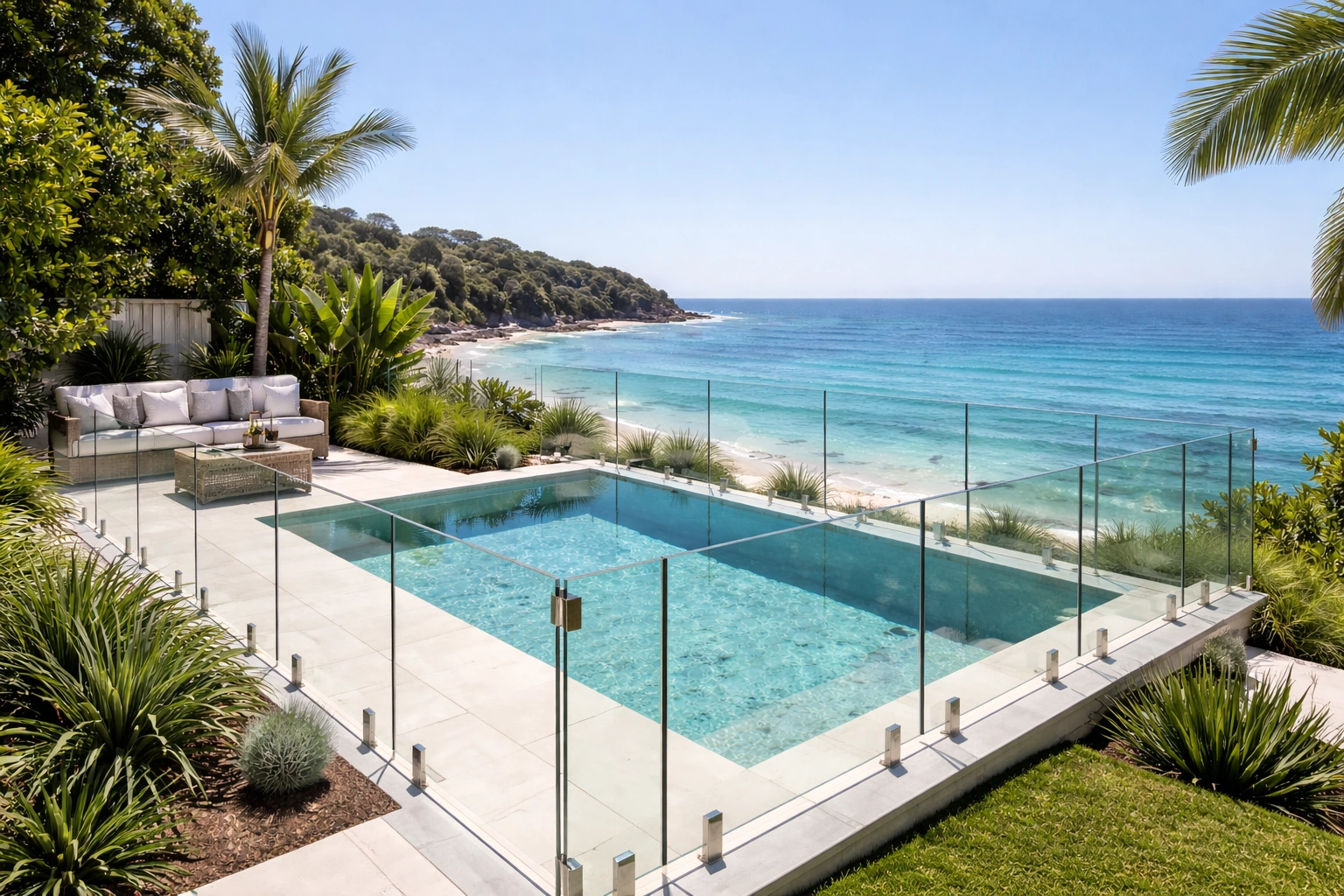
For families on the Central Coast, pool fencing is first and foremost about preventing drownings and serious accidents. Attractive design or clear views are valuable, but they come second to keeping children and pets safely separated from water unless an adult is present.
Safety remains the primary focus because residential pools are one of the highest risk areas around the home. Young children can slip away in seconds and pets can fall in silently without anyone noticing. A correctly chosen and professionally installed fence is the main barrier that stops a moment of inattention becoming a tragedy.
New South Wales has strict pool safety regulations for a reason. Toddlers are naturally curious and can drown in very shallow water in only a few minutes. Most incidents happen when adults believe children are inside or occupied, which means supervision alone is not enough.
The law requires a continuous barrier of a minimum height, with self-closing, self-latching gates and no climbable objects nearby. For homeowners, this is not just a compliance box to tick. It is a framework that reflects how accidents actually happen in backyards.
Glass pool fencing must not only meet the letter of the NSW Swimming Pools Act but also function reliably in everyday use with real families and pets. Proper design and installation ensure the fence performs as intended, rather than simply appearing compliant on paper.
Children test boundaries in very practical ways. They push on panels, lean on gates, drag chairs across the yard and try to climb anything that gives them a foothold. Pets can squeeze through gaps, dig at the base of fences or attempt to jump over lower barriers. Any weak point quickly becomes the path to the pool.
This is why safety must drive decisions about fence height, panel spacing, gate hardware and overall layout. For example, frameless glass with minimal footholds reduces climbing opportunities for young children. Correct ground clearance helps prevent small dogs from slipping underneath. Sturdy hinges and latches stop older children from forcing or lifting a gate when it should remain secure.
By considering how children and animals actually behave, fencing can be configured to close off the most common access routes to the water rather than simply meeting minimum measurements on paper.
Even a compliant fence can fail in practice if it is awkward to use or poorly positioned. Gates that do not latch smoothly are more likely to be left open. Fences set too close to doors or furniture can create climbable zones despite meeting basic height rules.
Safety focused design considers how the pool area is used day to day. That includes locating gates where adults naturally enter the area avoiding sharp corners in high traffic spots and allowing clear sightlines from the house to the pool so supervision is easier. It also means choosing quality hardware that self closes reliably and can withstand coastal conditions on the Central Coast so the safety features still work years after installation.
Glass pool fencing is specifically designed to limit how children and pets can approach or interact with the pool area. When correctly installed, it removes common footholds and handholds, making it difficult for children to climb or manipulate the gate while also restricting how pets can squeeze through or under the fence.
Every fence should comply with NSW pool safety regulations and be configured to reduce climbing risks around typical backyard layouts, including decks, garden beds and retaining walls. Proper placement, panel sizing and gate positioning all play a role in ensuring the barrier performs effectively in real-world conditions, not just on a plan.
One of the key safety benefits of glass pool fencing is its smooth, uninterrupted surface. Unlike traditional tubular or mesh fencing, there are no horizontal rails that can be used as a ladder. The panels are tall, flat sheets of glass, with no gaps for children to place their feet and no crossbars that make climbing easier.
Frameless and semi-frameless glass systems use minimal hardware, which further reduces potential footholds. Spigots and posts are positioned low and are difficult for children to use for climbing. The toughened safety glass is also highly rigid, making the panels harder to shake or flex compared with lighter materials that may be easier for a determined child to scale.
Attention should also be given to nearby features that could act as climbing aids. Regulations require that climbable objects such as planter boxes, benches, trees or pool furniture are kept a minimum distance from the fence so children cannot use them to gain height and reach over the top.
Unauthorised access typically occurs through the gate rather than over the fence, so gate design is critical. Glass pool gates are self-closing and self-latching, meaning that if someone forgets to pull the gate shut, it will automatically close behind them from any open position. This is particularly important in busy family homes where people move in and out of the pool area regularly.
The latch is positioned high enough that a small child cannot easily reach it from the outside. In compliant installations, the latch release must be at least 1.5 metres above finished ground level or located on the pool side with shielding so a child cannot reach through. Hardware should meet these requirements and the closing action must be tested to ensure the gate cannot be propped open or left resting ajar.
Hinges are also adjusted to close with enough force to overcome wind or minor obstructions while still being safe for fingers. Regular checks and simple maintenance, such as tightening loose hinges or replacing worn latches, help ensure the gate continues to perform as designed.
For pets, the primary risk is squeezing through gaps or digging underneath the fence. Glass pool fencing uses wide, solid panels with tight spacing, so small dogs or cats cannot slip between posts or rails. The clearance at the bottom of the fence is carefully set to comply with NSW rules and to prevent pets from crawling under, while still allowing for drainage and cleaning.
On properties with sloping ground or garden beds, panels can be stepped or custom heights used so the gap at the bottom remains consistent and does not become a pathway into the pool area. For larger or more agile dogs, taller panel options and secure gate latches that cannot be pawed open provide additional protection against unsupervised access.
Parents and pet owners often want to know how strong glass pool fencing really is and what happens if a panel breaks. The short answer is that compliant glass pool fencing is designed to be highly durable, resist heavy impact and, if it does fail, break in a way that reduces the risk of serious injury.
Safety glass used for pool barriers must meet relevant Australian Standards, with thickness and fixing methods selected to suit site conditions such as wind exposure and layout. Understanding the type of glass used, how thick it should be and how it behaves on impact helps homeowners feel more confident about choosing glass fencing around children and pets.
For pool fencing in NSW only Grade A safety glass is acceptable. In practice this means toughened (tempered) safety glass for almost all frameless and semi frameless systems.
Toughened safety glass is ordinary float glass that has been heat treated so the surface goes into compression. This makes it several times stronger than standard window glass and far more resistant to knocks from toys, balls and general play around the pool. When it does fail it breaks into small blunt cubes instead of sharp shards which significantly reduces the chance of deep cuts for children, adults and animals.
In some engineered systems toughened laminated glass may be used. This combines two sheets of toughened glass bonded by an interlayer. If one lite breaks the fragments tend to remain attached to the interlayer which can keep the panel largely in place until it is safely removed. This is sometimes preferred in high wind or high traffic commercial environments although standard toughened glass is typically suitable for residential Central Coast pools when correctly installed.
Glass thickness is critical for strength and stability. For most residential frameless pool fencing, 12 mm toughened safety glass is the current industry benchmark. In some situations, such as very long panels or exposed coastal sites, thicker 15 mm panels may be recommended to control flex and improve resistance to strong gusts.
Thinner glass, such as 10 mm, may be seen in older installations or simple balustrades but is generally not suitable for modern frameless pool barriers around active children and pets. Thicker glass provides:
Regardless of thickness, each panel must form part of a tested system that meets AS 1926 pool barrier requirements and local council rules.
No safety glass is completely unbreakable, so the key safety feature is how it behaves if it does fail. Toughened safety glass is designed to:
For children and pets, this means a far lower risk of severe lacerations compared with ordinary glass. The main hazard in the rare event of breakage is scattered particles on the ground rather than dangerous jagged edges at face height.
Correct installation is essential to support this breakage behaviour. Quality spigots or channel systems grip the glass securely so panels are not subjected to twisting stresses that could cause premature failure. Clearances around hard surfaces should also be carefully considered to minimise the chance of edge impacts from garden equipment or heavy objects, which are among the most common causes of glass breakage in pool fences.
The safety of a glass pool fence on the Central Coast depends heavily on the quality and correct setup of its gates and hardware. Even a strong fence can be ineffective if the gate is easy for a child to open or is left ajar. The right combination of gate design, latch type and self-closing system significantly reduces the risk of unsupervised access to the pool area for both children and pets.
Gate systems must comply with NSW pool safety regulations while also functioning reliably in everyday backyard use. This means installing gates that are positioned at the correct height, close firmly from any open position and use latches designed to be difficult for small hands and paws to operate. Proper adjustment and testing ensure the gate performs consistently rather than relying on occupants to remember to shut it securely.
A compliant glass pool gate must open outward, away from the pool, so that any force from inside the pool area pushes it more firmly closed rather than open. The gate must also meet the minimum height specified by local regulations to prevent a child from reaching over and unlatching it.
Glass pool gates are typically positioned at logical entry points from the house or along main pathways. This makes supervision easier, as adults can see and hear when the gate is used. Panels are aligned to prevent footholds or gaps that children or small dogs could use to climb or squeeze through. The bottom gap between the glass and the ground is kept small enough to stop small pets from crawling underneath while still allowing for drainage and easy cleaning.
For child and pet safety, the latch is often the most critical component of a pool gate. In NSW, a compliant pool gate latch must be positioned a minimum height above finished ground level so toddlers cannot easily reach it. Magnetic or mechanical latches are typically mounted high on the gate and often on the pool side, keeping them well out of reach of young children standing outside the fence.
Effective pool latches require a deliberate action to open, such as lifting and pulling at the same time. This dual action makes it much harder for children or even large dogs that jump against the gate, to accidentally release it. Quality latches should also be corrosion resistant, which is especially important in coastal Central Coast environments where salt air can cause sticking or failure that may leave a gate partially open.
Self-closing hinges or hydraulic soft-close systems ensure the gate returns to the closed position after every entry or exit. This is vital because many pool incidents occur when a gate is unintentionally left open. Hinges should be adjusted so the gate closes firmly enough to latch even in light breezes, which are common around coastal properties.
Soft-close or hydraulic hinges are particularly beneficial where children and pets are present. They slow the final part of the swing so the glass does not slam, reducing the risk of damage and minimising sudden noise that may startle pets. During installation, the closing speed and latching should be tested from different open positions, with fine adjustments made so the gate closes securely without needing to be pushed or manually checked each time.
Regular homeowner checks for smooth movement and positive latching complete the safety picture and help keep the gate performing as intended over time.
Glass pool fencing is a strong and compliant option for many Central Coast homes. However, it is not ideal for every family or every backyard. In some situations, another style of pool barrier may be safer, more practical or more cost effective in the long term.
Before committing to glass, it is important to consider how the pool area is used, who will be using it and the specific site conditions. The following scenarios highlight when it may be worth exploring alternative fencing solutions or combining glass with other materials to achieve the best outcome for safety and usability.
Families with big, energetic dogs or multiple pets need to think carefully about how animals interact with the fence. While toughened glass is very strong, repeated high impact from a large dog jumping at panels or charging along the fence line can stress fittings over time and may increase maintenance needs.
Dogs that are anxious or territorial can also leave heavy smears and scratches on the glass surface which means more frequent cleaning. In some cases a solid or semi-solid fence material can be better suited because it blocks visual triggers that cause barking and jumping.
If the household has dogs that like to dig, frameless glass on spigots might leave small gaps that require extra attention. A different style of barrier that continues lower into the ground can remove the risk of pets creating escape points under the fence.
Glass pool fencing needs regular cleaning to stay clear and safe. Fingerprints, water spots, coastal salt spray and pet nose marks can quickly build up on the Central Coast especially in windy or seaside locations. For busy households that already struggle to keep on top of chores this ongoing upkeep can become a real drawback.
If the fence runs close to garden beds or lawns, grass clippings and soil splash will also settle on the glass. This may mean more frequent washing during mowing season and after rain. Some owners are surprised by how often they need to clean the glass to maintain visibility into the pool.
In situations where the owner knows they will not keep up with this level of maintenance a powder coated aluminium or steel fence that hides marks more easily may be a more practical option.
Certain block layouts can make glass less suitable or more expensive to install correctly. Very sloping sites or older paved areas that are uneven can complicate the use of long frameless glass runs. While solutions can usually be engineered, they may require additional hardware or structural adjustments that shift the overall value equation for some homeowners.
Very windy or fully exposed coastal positions also require careful consideration. Strong gusts can cause gate panels to swing harder if hardware is not properly specified and maintained. In backyards where loose objects are frequently blown around, there is a higher risk of debris striking the glass, which increases the importance of regular inspections and sensible use.
In these situations, it can sometimes be more practical to combine materials. For example, glass may be used in primary viewing areas near the house, with more sheltered sections constructed in aluminium or another compliant material where exposure is greatest.
Ultimately, the safety of children and pets must sit at the heart of every pool fencing decision and that principle has guided everything outlined in this article. Glass pool fencing, when designed and installed correctly, addresses the core risks around pools. It creates a non-climbable barrier that limits footholds and handholds, closes off gaps that children and small animals might squeeze through and uses toughened safety glass engineered to withstand impact and break in a controlled, less hazardous way if it ever does fail.
Pairing the right glass type and thickness with high-quality, self-closing gates and compliant, child-resistant latches turns a simple barrier into a genuinely reliable safety system. At the same time, it is important to acknowledge that glass pool fencing is not automatically the right solution for every family or every site. High-traffic areas, very rough play environments, unsuitable ground conditions or situations where supervision is likely to be poor may call for a different approach or additional safety measures.
The key is to assess how your children and pets actually use the space, understand the relevant safety standards and work with a specialist team that can tailor a glass pool fencing solution or recommend alternatives that align with your safety priorities, lifestyle and long-term plans for your home.
Ready to elevate your space with stunning glass solutions? Contact Clearview Glass today for expert advice, quality craftsmanship, and unmatched customer service. Let's bring your vision to life – get in touch now for a consultation.


