You can arrange a window display carefully, check every product from inside the shop and still find that people walking past barely notice it. From the footpath, the reflected sky, passing traffic or the building opposite may be more visible than the merchandise behind the glass.
For Central Coast retailers, this can make it harder to attract passing customers and communicate what the business offers. Clearview Glass Group helps businesses explore suitable shopfront glazing options, but improving visibility does not always require replacing the glass. The first step is identifying why reflections dominate the display, how lighting and positioning affect what customers see, and whether different glazing could make a meaningful difference.
Your shop window presents two views at once: the display behind the glass and a reflection of the surroundings in front of it. When the reflected scene is much brighter than the display, it can dominate what people see from the footpath.
That does not necessarily mean the glass is faulty or unsuitable. It means the relationship between outdoor brightness, interior lighting and the display itself needs a closer look.
Imagine a brightly lit footpath opposite a shop with a shaded interior. Some light from the products passes through the window towards pedestrians. At the same time, the glass reflects some of the brighter outdoor scene back towards them. These two views overlap rather than appearing separately.
A pale building opposite can place a broad, bright reflection across the window. Reflected vehicles can introduce moving shapes, while a patch of sky may wash across the upper half of a display. Products remain physically visible through the glass, but their outlines and details become harder to distinguish.
Dark merchandise against a dark interior is particularly vulnerable because there is little visual separation to begin with. A shopper may register a window, a reflection and some indistinct shapes without recognising what is for sale. The problem is often less about seeing through the glass and more about understanding the display quickly.
Your eyes also adjust to their surroundings. A display that seems adequately lit while you stand inside may appear much dimmer when you step onto a bright footpath. Checking it from the shop floor alone can therefore give you a misleading impression of retail display visibility.
Ordinary clear glass transmits much of the visible light reaching it, but it also reflects some light at its surfaces. This happens because light changes direction and partially reflects when it passes between materials with different optical properties, such as air and glass.
Clear does not mean reflection-free. The strength of the visible reflection depends on the glass, lighting conditions and the angle from which someone looks at it.
Looking along a window at a shallow angle often makes reflections more noticeable than looking towards it directly. This helps explain why a display may look acceptable when you stand opposite the shop, yet seem obscured as you approach from the side.
Surface dirt, streaks or marks can add another distraction, but cleaning cannot remove the reflection created by the glass itself. If the window is clean and the display still disappears at particular times, note exactly what is reflected over it. A bright strip across product labels calls for a different discussion from a reflection covering the entire display throughout the day.
Shop window reflections are not a fixed condition. The same display can be readable in the morning, obscured around midday and clear again later, even though nothing inside the shop has moved.
A useful assessment follows your actual trading hours and the paths customers take. One photograph from directly in front of the window is rarely enough to explain the problem.
As the sun moves, it changes which outdoor surfaces are brightly illuminated. A building opposite may be shaded early in the day and strongly lit later. When that brighter surface is reflected in your window, it can compete more strongly with the display behind it.
Direct sunlight does not need to strike your own shopfront for this to happen. A shaded shop can still reflect a sunlit street. This is vital for retail frontages beneath awnings, as shade over the glass does not automatically prevent reflections from across the road.
Cloud cover can change the balance too. A bright overcast sky may produce a broad reflection, while broken clouds create more variable conditions. The most useful record includes the time, weather and which part of the display becomes difficult to see. That gives a glazing professional more context than a general description that the window is too reflective.

Customers do not all stop squarely in front of the glass. They approach from either direction, glance sideways and continue walking. A display needs to communicate something from these moving viewpoints, not only from the best viewing position.
Walk towards the shop from both directions and notice when the main product first becomes recognisable. Check a closer position near the window and a more distant position across the available footpath, without obstructing pedestrians. Reflections may cover different products at each point.
Photographs can help you compare conditions, but phone cameras automatically adjust exposure and may exaggerate or soften the difference between indoors and outdoors. Treat them as a record alongside your observations rather than a perfect representation of what every passer-by sees.
Record the specific obstruction, such as reflected sky across faces on a poster, moving traffic over smaller products or a bright wall behind price labels. These details help you decide whether to reposition the display, change its background or investigate the glazing's characteristics.
The first improvement may be a merchandising change rather than a glass replacement. A simpler display with a clear focal point gives customers a better chance of recognising products through competing reflections.
Business Queensland’s guidance on effective retail display design offers practical ideas for using lighting, colour and clear sightlines to draw attention to merchandise.
Start with the element you most want people to notice. Test its outline, background and position from outside before rearranging the entire window.
Contrast helps separate merchandise from everything behind it. A pale product against a similarly pale interior can lose definition, just as a dark product can disappear against dark shelving. Changing the immediate background may make the product easier to recognise without changing the window itself.
That does not mean choosing the brightest possible backdrop. A very bright surface can become the dominant feature and leave the merchandise looking comparatively dull. Aim for a clear difference in tone or colour that supports the product rather than competing with it.
A limited background can also reduce visual clutter from deeper inside the shop. Shelving, signs and customers moving behind the display all create additional visual layers. You do not necessarily need to conceal the interior, but the main product should not have to compete with every detail beyond it.
Test signs as part of the same arrangement. Small lettering may be readable from inside yet disappear behind reflected shapes outdoors. A short message with distinct lettering is often easier to recognise during a passing glance than several lines of information. Check that a reflection does not repeatedly cross the most important words.
Moving a product closer to the glass can change what sits behind it and how it overlaps with reflected scenery. Moving it further back may give you more control over the background or illumination. Neither position is universally better, so compare a few practical locations rather than assuming the front edge is always best.
Height matters as well. If the reflected sky consistently covers the upper window, a small adjustment may place the key item in a more readable area. Test this from both pedestrian approaches because the apparent overlap changes with your viewpoint.
For a compact frontage, these decisions also affect if the window feels crowded. The principles behind making a small shopfront look bigger with glass can help you consider openness alongside the need for a distinct display.
Lighting can help a display compete with reflections, but adding more light is not automatically the answer. Its direction, distribution and effect on the merchandise matter as much as its brightness. When planning changes, consider energy-efficient lighting for retail premises alongside display visibility to help manage ongoing operating costs.
The glass also affects how much display light reaches the footpath and how colours appear. Lighting and glazing decisions therefore need to be considered together rather than as separate fixes.
Useful display lighting reveals the product's shape, surface and important details. A bright patch on the floor or backdrop does little for merchandise left in shadow. It may even draw attention away from the item you want customers to notice.
Visible lamps and reflected fittings can become additional distractions in the window. From outside, check whether you see the illuminated product or mainly a series of bright points. A fitting that appears unobtrusive from the shop floor may be prominent from a pedestrian's viewing angle.
Increasing interior lighting can improve visibility in some circumstances, when the display is poorly illuminated compared with its surroundings. However, the result depends on the brightness outside, the glass and the lighting arrangement. A display that looks bright at night may still struggle against strong daytime reflections.
Uneven illumination can also make labels difficult to read or flatten the appearance of textured products. The aim is not to flood the entire frontage indiscriminately but to make the chosen display legible from the street. That requires assessing the result through the existing glass under actual trading conditions.
Tinted glass and reflective glass are not necessarily the same thing. Tint changes the amount and colour of light passing through the glass, while reflective coatings or treatments are designed to alter how much light is reflected from its surface.
Darker glass should not automatically be assumed to reduce the reflection problem. If it reduces the amount of light transmitted from the display, products may become less visible from outside. Some reflective glazing products can also create a more mirror-like exterior appearance.
Colour is another consideration. Glass and lighting can each influence the apparent colour of merchandise. A product that looks neutral inside may appear different through a particular glazing sample, especially against a pale background.
Anti-reflective glazing can be discussed with a supplier when reflections are the primary concern. However, not every specialised product suits every shopfront, and availability, installation requirements and expected performance need to be assessed for the specific project.
The broader relationship between shopfront visibility and street appeal is useful context, but display clarity still needs to be tested against your particular conditions.
Replacement deserves consideration when the existing glass is a part of the visibility problem, but it should follow an assessment rather than a guess. A useful conversation starts with what customers cannot see and under which conditions.
If you are comparing suppliers for shopfront glass in Central Coast, ask how they would assess your display from the footpath before recommending a product. Experts can discuss project-appropriate options and if representative samples are available.
Visible light transmission describes how much visible light passes through a glazing product. Reflection characteristics describe the light reflected from it. Both are relevant because customers are trying to see transmitted light from your display through a reflected outdoor scene.
Ask for information about the exact proposed glass rather than relying on a broad description such as clear or tinted. Different products and glass configurations can perform differently. The comparison is between your existing glazing, where its specification can be established, and the replacement being considered.
A transmission figure alone does not tell you how readable the display will be. Exterior brightness, viewing angle and lighting still influence the result. Similarly, a reflection figure should not be treated as a promise that a window will look reflection-free in every setting.
Ask the supplier to explain the likely trade-offs in plain language. What improvement is reasonable to expect? Which reflections may remain? Would the proposed glass affect product colour or make the interior appear darker? These questions are more useful than asking for the clearest glass without defining what clarity means for your shop.
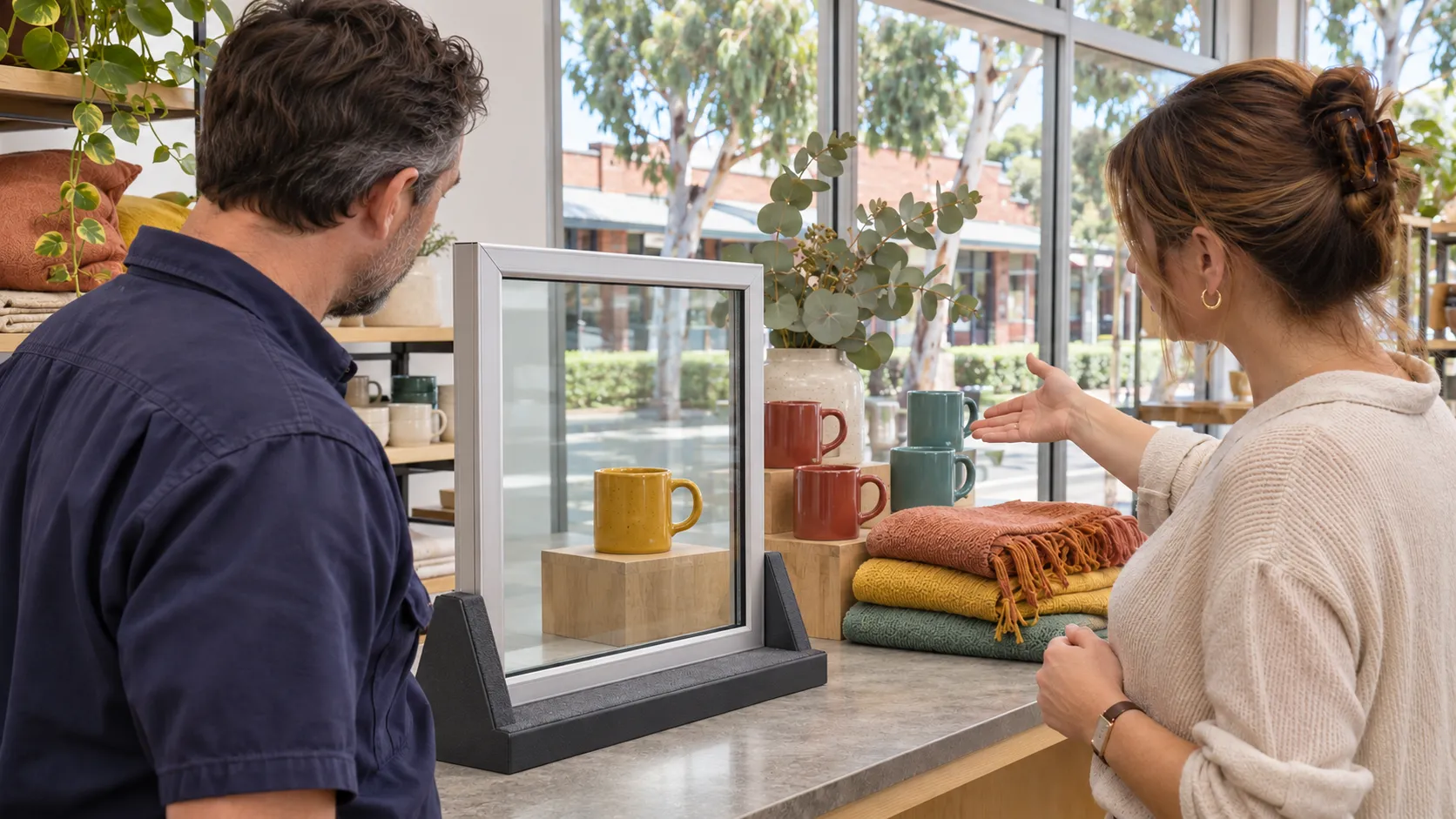
A representative sample can help you judge colour and apparent clarity, particularly when viewed with your actual merchandise. Ask whether the sample represents the proposed thickness, makeup and any treatment, since a different piece of glass may not provide a meaningful comparison.
Where practical, assess it under conditions resembling the shopfront rather than only under indoor showroom lighting. A small sample cannot reproduce every effect of a full window, but it can reveal a colour cast or appearance you would otherwise miss. Sample handling and any on-site positioning should be managed safely by the glazing professional.
Discuss the expected visual performance under the conditions you recorded earlier. If reflections are strongest during afternoon trading, for example, ask how the proposed option is expected to perform under similar outdoor brightness and viewing angles.
A successful improvement makes the important parts of your display easier to recognise during the trading conditions that matter. It does not require the window to disappear or every reflection to be eliminated.
For retailers, the best approach is to consider merchandising, lighting and glazing together. Professionals will assess suitable shopfront glass options when the existing glazing appears to be contributing to poor display visibility.
Visibility is one part of a glazing decision, not the only requirement. The opening’s size, the way the glass is supported and its position near doors or pedestrian areas all affect what may be suitable. Have a qualified glazing professional assess those factors rather than selecting a product on appearance alone.
A glass option with attractive optical characteristics is not automatically appropriate for every existing frame or shopfront arrangement. Ask the supplier to explain any limitations that affect your frontage and how those limitations influence the available choices. This keeps the discussion connected to the actual installation.
It also helps to define what you need customers to recognise. For one display, the priority may be the outline and colour of a featured product. For another, it may be a short message or a group of smaller items. Trying to make every detail visible from every angle can lead to unnecessary changes without a clear benefit.
Agree on realistic expectations before committing to replacement. Know which viewing positions and times of day informed the recommendation. If reflections are strongest only briefly, that deserves a different assessment from a window that remains difficult to see through for most of your busiest trading period.
Once you have tested merchandising and lighting adjustments, review if they have made the display easier to recognise. Consider whether customers can identify the featured product sooner, whether important labels remain readable and whether the improvement works from both directions along the footpath.
If visibility remains poor despite these changes, your observations can help a glazing supplier understand the problem. Provide photographs, trading times and details of the display arrangement you intend to retain. This gives the supplier a consistent brief for assessing replacement options.
Not every shopfront needs new glass to achieve better visibility. However, when reflections remain an obstacle, choosing suitable glazing can be an important part of improving how your business presents itself to passing customers. With practical advice and project-appropriate options from Clearview Glass Group, you can decide about your shopfront and create a display that is easier for customers to notice from the street.
Ready to elevate your space with stunning glass solutions? Contact Clearview Glass today for expert advice, quality craftsmanship, and unmatched customer service. Let's bring your vision to life – get in touch now for a consultation.


