Glass balustrades around elevated pools and decks are no longer just a design feature. On many projects, they play a critical role in safety, compliance and the overall quality of the finished build. For builders, getting the details right early matters, especially where pool fencing laws, structural requirements and site-specific conditions all intersect. Clearview Glass regularly works with builders on these more complex installations, where uninterrupted views, premium finishes and strict compliance requirements all need to be balanced from the outset.
This article explains how height and fall risks can change the requirements for glass pool fencing on raised entertaining areas, how wind load, site exposure and substrate type influence hardware selection and glass thickness, and how boundary conditions, privacy and overlooking controls can affect layout decisions. With the right planning before quoting or framing begins, builders can avoid costly redesigns, reduce approval delays and deliver compliant installations that reflect the standard of workmanship clients expect.
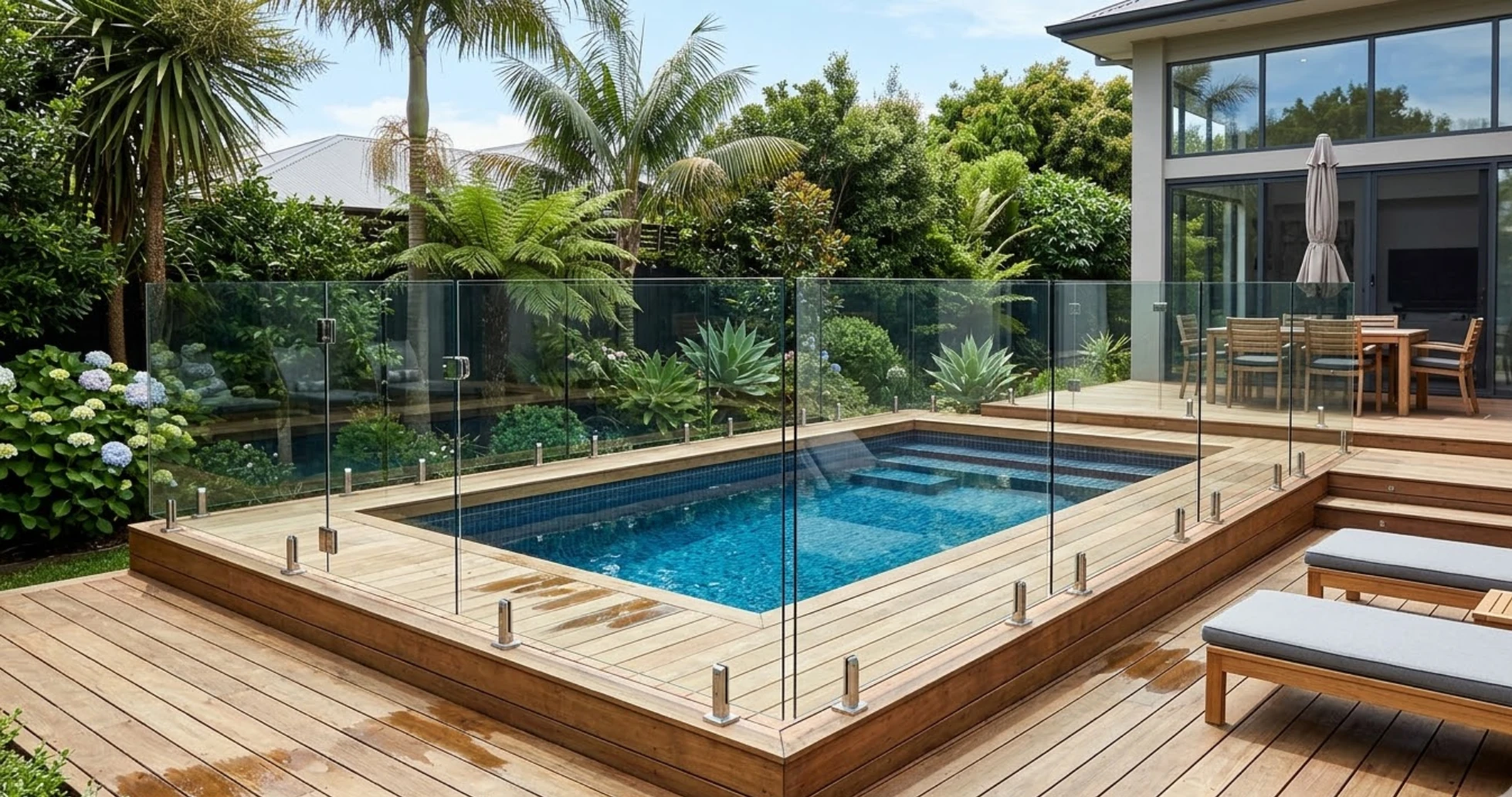
In New South Wales pool fencing laws are strict, and they apply equally to pools beside, raised decks and entertaining areas. For builders this means treating a pool on or next to a deck as a full compliance project, not a simple balustrade job. The height of the deck, distance to the water’s edge and access points all affect how glass fencing must be designed and installed.
Pool fencing experts work within the requirements of the Swimming Pools Act 1992 and the Swimming Pools Regulation 2018 as interpreted in AS 1926.1. When a pool interacts with a raised entertaining area, the main issues are effective isolation of the pool, compliant fence height relative to finished surfaces and elimination of climbable elements.
NSW law requires a continuous child-resistant barrier at least 1200 mm high measured from the finished ground level or deck surface on the outside of the pool area. For a pool adjacent to a deck, this means the fence height must be checked against the highest standing surface a child could use to approach the barrier, including steps built into the deck.
Climbable zones are critical. Within 900 mm of the outside of the fence there can be no horizontal surfaces, projections or handholds between 100 mm and 1200 mm above the approach surface. On raised entertaining areas this often affects:
Gaps under and between glass panels must be less than 100 mm. For a deck that may move slightly over time due to timber shrinkage or structural deflection, pool fencing specialists allow for tolerances so clearances remain compliant.
If the deck is within the prescribed non-climbable zone around the pool, the law usually treats it as part of the pool area. In practice that means access from the house to the deck must be controlled by a compliant barrier, not only from the deck to the water.
Where the house opens directly onto a raised entertaining area besides the pool, the builder must decide whether to:
Pool fencing experts typically coordinate early with designers so the chosen approach can be detailed and costed before framing begins.
Any gate in the pool barrier must open away from the pool, be self-closing from any position and self-latching at a height of at least 1500 mm. On raised decks this becomes more complex where the gate is located at the top of stairs or beside steps.
Level changes can create non-compliance if the fence layout does not follow the actual walking surfaces. If a section of deck is later built up with tiles or outdoor flooring, the effective fence height is reduced. Glass panel heights and channel locations should only be set after final finished levels are confirmed on site so the legal 1200 mm barrier is maintained.
For raised entertaining areas that sit besides a pool it is common for the deck edge to effectively become part of the pool fence line. At that point the balustrade is no longer just a fall‑protection element. It also functions as a pool barrier and must comply with pool safety provisions as well as the usual balustrade requirements.
Pool fencing experts regularly help builders identify when this crossover occurs and how to detail a glass system that satisfies both roles. Misjudging this early can lead to failed inspections, redesign and costly rework, so it is critical to understand the triggers in the relevant Australian Standards and state regulations.
A deck balustrade is treated as a pool, barrier whenever it forms part of the continuous enclosure that separates the pool from the dwelling or general outdoor areas. Typical triggers include:
In these situations the glass along the deck perimeter must comply with the pool barrier standard AS 1926 in addition to the balustrade and structural glass requirements of AS 1170 and AS 1288.
For pool barriers the critical dimension is measured from the finished pool surround or adjacent ground levels. not just from the deck floor. Where the deck balustrade becomes the pool fence, experts advise builders to confirm all finished levels early, including:
The pool barrier must generally reach at least 1200 mm above the adjacent finished surface and maintain compliant clearances at the base. Features such as bench seating, wide top rails, planter boxes or horizontal framing close to the glass can create climbable elements within the non‑climbable zone.
Where the only practical pool entry is from the raised entertaining area, the gate will be set within the deck balustrade line. At that moment the gate and its supporting structure become pool safety items rather than just architectural features.
To comply, the gate must:
Builders should allow for additional structure under the gate area to support the higher impact and movement loads. Professional pool fencing installers typically coordinate gate panel widths, hinge types and fixing details with the builder so the same glass alignment can serve as both a visually continuous balustrade and a fully compliant pool barrier.
Structural fixing is the critical difference between glass pool fencing on ground level and fencing on a raised entertaining area. At height, the loads on glass, posts and fixings are amplified and any failure can have serious consequences. Builders must ensure the substrate, fixings and glass support system are engineered as a single, compliant structure, not as separate components.
Pool fencing installers work with builders to match fixing methods to the actual build-up of the deck or slab. This means confirming what is behind the finished surface, how loads will be transferred back to the structure and how corrosion will be controlled over the life of the fence.
The starting point is to identify exactly what the fencing is being fixed into. A raised entertaining area might be:
Each substrate has different pull-out capacities and deflection characteristics. For example, frameless glass spigots on a cantilevered concrete balcony typically require core-drilled or heavy-duty surface-mounted fixings into the structural slab, not just the topping or tile bed.
Edge conditions are equally important. Balustrade-type loads at the edge of a slab create leverage on fixings. Engineers may specify minimum slab edge distances, thicker slab zones or additional blocking or steel plates beneath the finished surface to manage these forces.
For elevated pool fencing the fixing system is usually treated to balustrade standards rather than simple barrier standards. This often means:
Pool fencing experts recommend that builders obtain project-specific engineering where the fall height or site conditions increase risk. Engineers will check line load requirements, panel deflection and fixings under crowd load or wind load and will often nominate exact anchor types, embedment depths and spacing.
On tiled or waterproofed slabs, fixing locations must be coordinated to protect membranes. This may require core drilling with sealed sleeves or pre-installed blocking before waterproofing. Poor detailing here can lead to water ingress and slab deterioration that eventually compromises the fixings.
Elevated installations are more exposed to wind-driven rain and sometimes to coastal salt, which accelerates corrosion. Structural fixings for glass pool fencing in these locations should typically be:
Builders should avoid standard zinc-plated anchors or untested proprietary screws in structural roles. Pool fencing installers can advise on anchor brands with proven performance in Australian conditions and can coordinate with engineers to ensure the selected fixings match the design assumptions for the raised entertaining area.
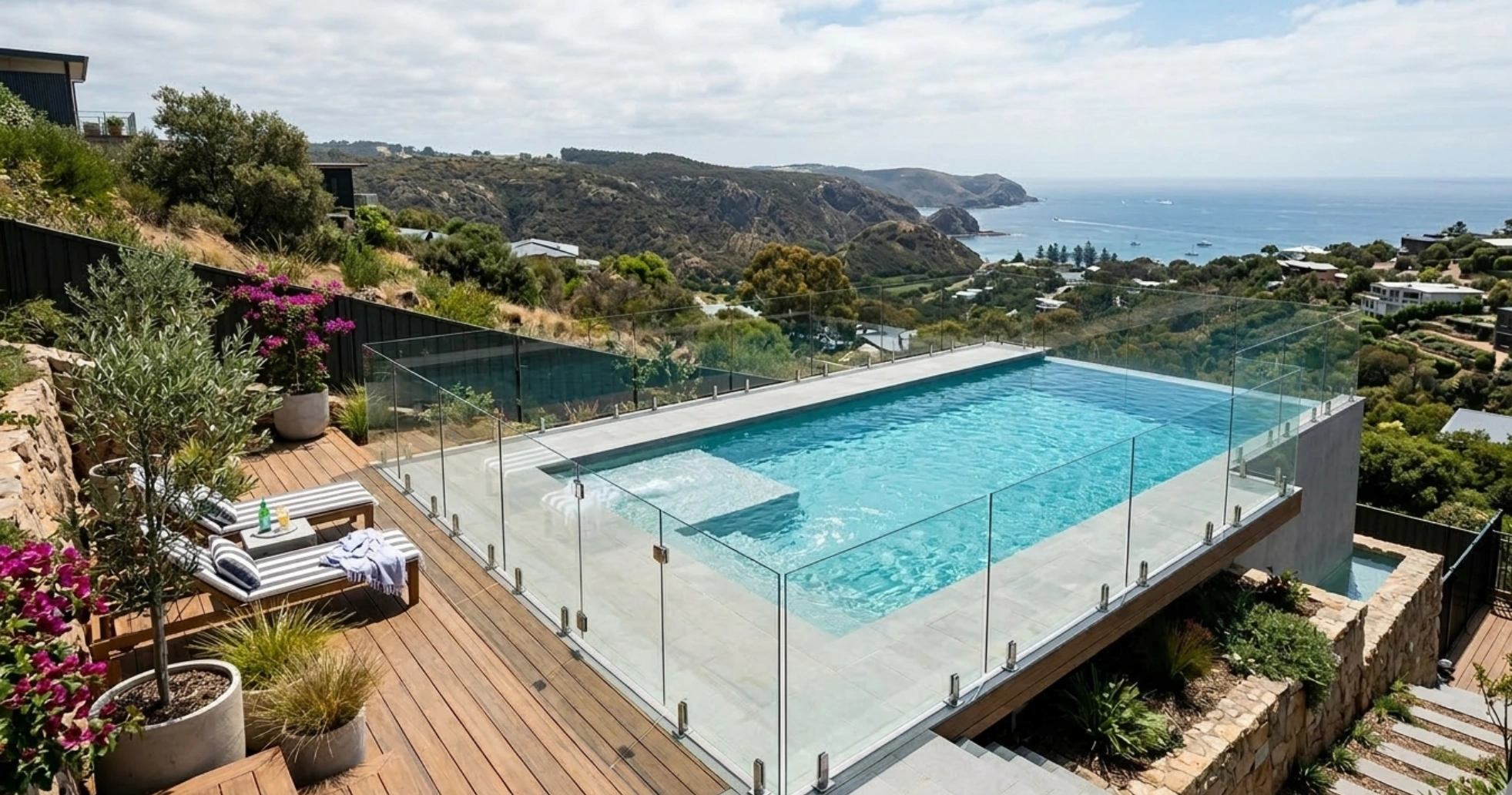
Designing glass pool fencing in Central Coast around sloped or stepped entertaining areas requires much more than simply following the pool edge. Builders must consider level changes, fall risks and structural fixing so the fence complies with pool barrier laws while remaining visually light and practical to build. Pool fencing installers work with gradients, stairs and retaining elements regularly, so layout and fixing choices are critical from the earliest design stage.
Irregular ground can quickly create climbable zones, non-compliant heights or fixing points too close to retaining edges. Thoughtful planning of fence lines, step locations and retaining walls helps avoid on-site compromises that are costly to rectify once concrete or paving is in.
Raised entertaining areas often include upper and lower decks or terraces around the pool. The key question is which level is treated as part of the pool area and which must sit outside the barrier. Poor early decisions here can lock the client into awkward gate positions or impractical circulation.
A common approach is to include the primary entertaining deck within the pool zone and then separate it from secondary outdoor spaces with glass fencing and a self-closing gate at the stair landing. Pool fencing experts work with builders to align panel joints with stringers and landings so no gap at steps exceeds allowable limits and handrails do not create climbable paths into the pool area.
Retaining walls around raised pools and terraces influence where glass can be fixed and how loads are transferred into the structure. Core-filled blockwork or engineered concrete walls usually suit base-plated or core-drilled spigots, while lightweight sleeper or gravity walls often require the fence to be set back onto stable slabs or footings.
Pool fencing experts evaluate whether the glass should sit:
Each option affects perceived height on both sides and can change whether the retaining is considered climbable. Waterproofing is another consideration, as penetrations into retaining caps and suspended slabs must be detailed to avoid future leaks.
Raised entertaining areas introduce extra fall risks around pools, so compliance issues tend to be magnified. Pool fencing experts often see otherwise high-quality work fail inspection because small gaps or level changes create unintended footholds or climbable zones that do not exist on ground-level installs.
Understanding the most common failures helps builders plan layouts, choose the right hardware and coordinate trades early so the glass barrier is continuous, non-climbable and at the correct height relative to all adjacent surfaces.
One of the most frequent problems is measuring fence height from the structural deck instead of the final finished surface. Tile, composite decking or levelling compounds can easily add 20 to 40 mm, which can push the effective fence height below the minimum requirement once installed.
On raised platforms this is critical because the fall height to lower levels may trigger stricter interpretations from certifiers. Builders should confirm:
Builders should also avoid installing glass before external finishes are complete unless the fencing layout has been set out from locked-in finished levels.
Raised entertaining areas often combine bench seating, planter boxes, retaining walls and wide stair
treads. These are convenient for clients but can easily form a step system that defeats the pool barrier.
Typical compliance failures include:
To minimise risk, builders should design furniture and planters either outside the non-climbable zone or at heights that do not create an intermediate step. If permanent joinery must be nearby, pool fencing specialists will often recommend taller glass or a redesigned barrier line to keep the non-climbable zone clear.
Where a raised entertaining area meets lawns, lower terraces or garden beds, the transitions often cause non-compliant gaps. Small changes in level can produce wedge-shaped openings at the base of glass panels or gates that exceed allowable limits.
Common trouble spots include:
These issues usually arise because the barrier layout is designed in plan without fully accounting for vertical geometry. Professional pool fence installers encourage builders to provide accurate section drawings and site levels so spigot positions, edge distances and panel sizes can be set to maintain consistent clearances and avoid compliant height being lost at steps or drops.
Certification, inspection and ongoing risk management are critical for raised entertaining areas because any failure at height can have catastrophic consequences. Builders need to understand not only how to achieve initial compliance for glass pool fencing but also how that compliance is maintained over the life of the structure.
Pool fencing experts support builders through the approval process and help set up owners for long-term safety. That starts with correct documentation and installation, then continues with planned inspections, maintenance and risk controls tailored to elevated sites.
Before construction, builders must confirm that the proposed glass pool fencing system is certified to the relevant Australian Standards for pool barriers and glass balustrades. This is particularly important on raised decks where the barrier performs a dual role as both pool fence and fall protection.
Key elements include:
For raised entertaining areas, certifiers will look closely at edge conditions, transitions between deck and ground and any level changes that could reduce the effective barrier height. Pool fencing installers work with builders to provide layout drawings, fixing schedules and manufacturer data so private certifiers or building surveyors can review and sign off efficiently.
On-site inspections typically occur at two key stages: structural fixing and final completion. For raised entertaining areas, inspectors focus on how the glass barrier is anchored to the deck structure, slab edge or steelwork, as fixings at height are subject to additional load paths and potential movement.
Builders should ensure:
Before handover, it is worth carrying out a joint walkthrough to identify any potential non-conformances, such as nearby furniture that could create climbable zones or changes to landscaping that affect barrier height.
Once certified, the barrier remains a critical safety system that must be managed over time. Builders can add value by setting clear expectations for owners regarding inspections, cleaning and repair.
For raised glass pool fencing, experts advises:
Corrosion is a higher risk on exposed upper levels and coastal sites, so stainless steel fittings, anchors and balustrade components should be monitored for surface staining or pitting. Any modification to the deck, such as new stair access, pergolas or screening, should trigger a review to confirm that the original barrier design still complies.
By treating certification as the start of a managed safety lifecycle rather than a one-off event, builders can reduce liability and provide owners with a clear roadmap to keep raised glass pool fencing both compliant and secure for the long term.
Glass balustrades around raised pools and decks require much more than a standard fencing approach. Builders need to account for pool safety laws, structural loading, finished levels, fixing methods and long-term durability from the earliest stages of design and construction. When these details are addressed properly, the result is a barrier that not only meets compliance requirements but also supports the overall finish, safety and usability of the space.
By understanding how pool barrier rules, balustrade performance and site-specific construction factors overlap, builders can reduce the risk of delays, failed inspections and costly rework while delivering a finished result that meets both regulatory requirements and client expectations.
Ready to elevate your space with stunning glass solutions? Contact Clearview Glass today for expert advice, quality craftsmanship, and unmatched customer service. Let's bring your vision to life – get in touch now for a consultation.


